
Design Thinking
-
Thinking Tools for Innovation

The three reasoning approaches serve distinct but complementary roles in innovation, with each suited to different phases and types of challenges. Deductive reasoning applies established theories and frameworks to specific situations, working from general principles to specific conclusions. You can use deductive reasoning to apply the established theory, “build market share and profits will follow,”… Continue reading
-
Ivory tower assumptions

An interesting story from the mid-90s, when US carmakers wanted to enter the Indian market. However, the prices of their cars were high for the Indian market. So, they asked the car designers which features from the car could be eliminated to make it affordable. Designers made an assumption by looking at US customers and… Continue reading
-
Innovation without ecosystem is merely an invention
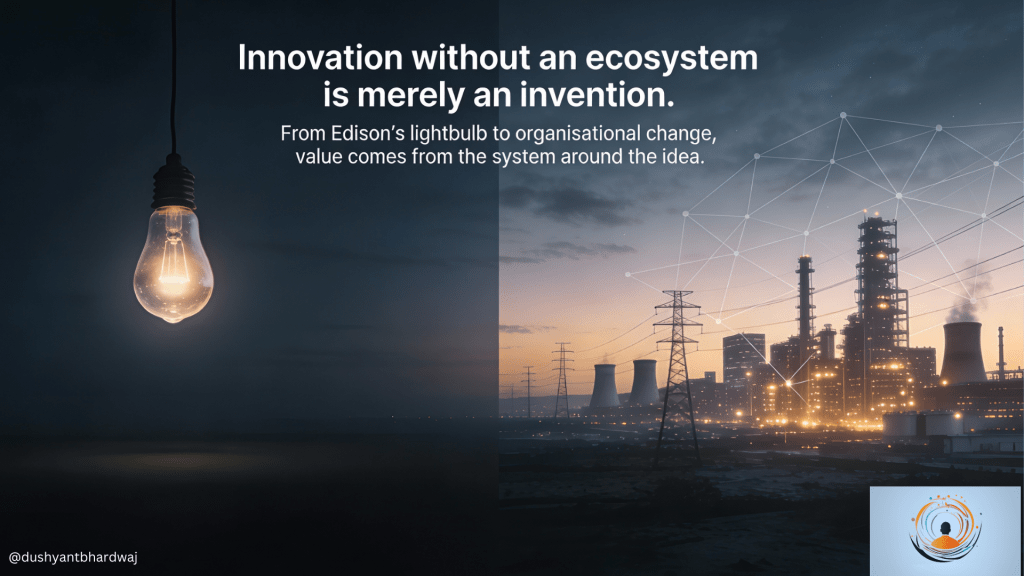
Thomas Edison wasn’t technically the inventor of a light bulb. Decades before him, inventors such as Ebenezer Kinnersley (1761) and Humphry Davy (early 1800s) did a great amount of work to create incandescent lamps. However, Edison turned the electric lightbulb into a practical product and wrapped an entire ecosystem around it. Edison understood that the… Continue reading
-
Good detectives and Bad criminals
John Seely Brown shares “In learning to recognise and distinguish information, people behave like good detectives, continually working with the clues that they find at the scene, extrapolating from partial evidence to the whole story. To engage these practices, good designers, by contrast, need to be more like bad criminals than good ones, always leaving… Continue reading
-
Observe what people do, not what they say?
A lot of time we try to conclude from the feedback we get from focus groups, consumer insights etc..But what people say in a focus group setting may not be what they actually want. In a landmark study, when Sony was introducing the boom box, the company gathered a group of potential customers and held… Continue reading
-
How a good eco-system could turn into a bad eco-system?
Very thought provoking story of Zion National Park, Utah. Zion Canyon first settled by ranchers in 1862. When ranchers abandoned the canyon in 1918 it was established as a national park and became popular among visitors. A large number of visitors scared the wildlife animals like Cougars(Puma), hence the Cougars population started to decline. Since Cougars are… Continue reading
-
How can you be a creative type?
As I discussed in my last blog, creativity is a muscle which can be strengthened. You can follow simple steps for this: Choose creativity – Decide; you want to make it happen. Think Like a Traveler – Expose yourself to new ideas. Engage relaxed attention – allowing the mind to make new connections between seemingly… Continue reading
-
Are you a creative type?
We have always thought creativity as a God-gifted skill. Right from childhood we start differentiating ourselves as either creative or analytical. However attaching creativity with a particular skill like art or craft is a myth. Tibetan language doesn’t have any word for ‘creativity’ or ‘being creative’. The closest translation is ‘natural’. So if you want… Continue reading
-
Design Thinking Series – Part 1
In his book ‘Change By Design’, Tim Brown advises the need of design thinking specially in today’s technology driven world.As technology becomes more and more complex applying design thinking principles to your product or service will be key differentiator. A balanced approach which not only looks into technology and analytics but considers the factors of… Continue reading
 Thinking Space