
WYSIATI: What You See is All There Is!
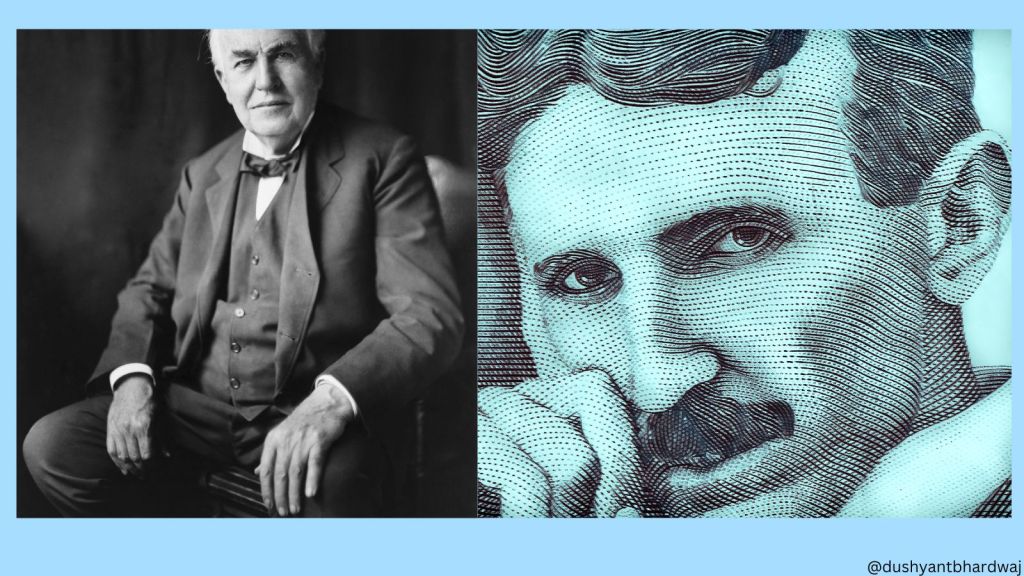
Both Edison and Tesla were considered great inventors. Edison was known more as a practical inventor who produced inventions largely through trial and error. Lacking sophisticated training in mathematics or engineering, Edison instead applied a famous work ethic to produce new ideas through brute trial and error, arguing that invention is “one percent inspiration and ninety-nine percent perspiration.” He is credited with inventing the phonograph, the motion picture camera, the alkaline battery, and, most importantly, the electric light bulb and the accompanying distribution system for electric power.
By contrast, Tesla grew up in Europe and showed early signs of genius. His ability to perform integral calculus in his head led his tutors to think he was cheating. He attended Joanneum Polytechnic in Graz, Austria, one of the world’s best technical institutions. After his studies, Tesla briefly worked with Edison early in his career. Although he admired Edison’s work ethic, Tesla had an opinion about Edison’s approach: “His method was inefficient in the extreme . . . I was almost sorry to witness his doings, knowing that just a little theory and calculation would have saved him ninety percent of the labor.
Tesla’s genius and education led him to develop the foundations for electric induction motors, wireless telegraphy, radios, neon lamps, and remote control. In fact, his inventions in three-phase electric power and alternating current eventually enabled the global distribution of electricity as we know it.
However, although Tesla’s ideas arguably were more brilliant, he was unable to commercialize his ideas. He died virtually penniless in a hotel room in New York. In stark contrast, Edison died wealthy in his New Jersey mansion having won the Congressional Medal of Honor and having his birthday, February 11, designated as National Inventor’s Day.
If Tesla’s ideas ultimately had more impact, then why was Edison so much more successful?
The key reasons that are attributed to Edison’s success are his ability to win backers, colloborators and attention for his ideas. Edison worked purposefully to fashion an image of himself as hardworking, hands-on inventor, he even once reportedly smeared soot on his hands and face before an interview to bolster that reputation.
How often we make our judgments/perception based on limited information or evidence that is right in front of us, without considering other potentially relevant factors? Sad reality is that it is more often than you think.
On a positive side there is nothing wrong in building an innovation capital (human + social + reputation) for your innovation efforts.
Sources & adapted on Innovation Capital.

 Thinking Space